Carved Teak Votive Panel From Andhra Pradesh – Late 19th Century
This distinctive late 19th-century teak votive panel originates from Andhra Pradesh in South India and was traditionally used to adorn village homes, domestic shrines, and sacred spaces. Hand-carved by local artisans, such panels served both decorative and symbolic purposes, often drawing inspiration from temple architecture and devotional imagery. Their compact scale and deeply worked surfaces create a striking sculptural presence that belies their modest size.
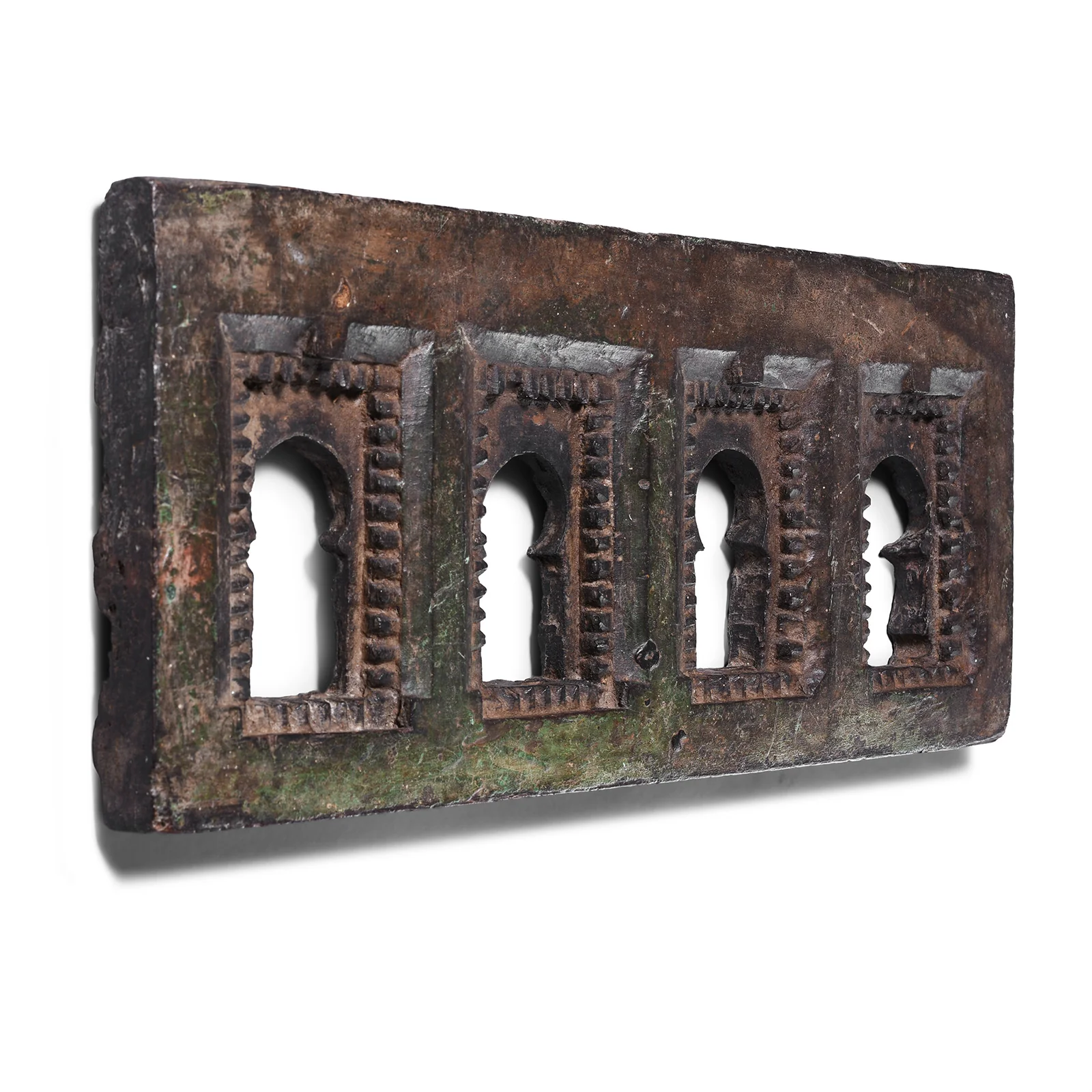
Carved from solid teak, this example features a series of four stylised shrine-like openings framed by finely cut geometric detailing. The repeated forms evoke miniature temple façades or sacred niches, creating a rhythmic architectural composition. Over many decades the surface has acquired a rich, dark patina, with traces of age, wear, and weathering that enhance the depth of the carving and speak to the panel’s long history of use.
Once mounted on the walls of a dwelling or shrine as an object of protection and devotion, the panel now serves as a fascinating piece of folk art. Displayed individually or alongside other architectural fragments, it brings texture, character, and a tangible connection to South India's vernacular traditions.
- Origin: Andhra Pradesh, India
- Date: Late 19th Century (circa 80–120 years old)
- Materials: Solid Teak
- Features: Hand-carved votive panel, four shrine-like openings, geometric detailing, architectural folk art, rich aged patina, ready for wall display
- Condition: Age-related wear, minor losses, weathering, and surface imperfections consistent with age and use
- Dimensions: W46 x D3 x H19 cm
Product Information
Product Information
Shipping & Returns
Shipping & Returns


Carved Teak Votive Panel From Andhra Pradesh – Late 19th Century
Carved Teak Votive Panel From Andhra Pradesh – Late 19th Century
This distinctive late 19th-century teak votive panel originates from Andhra Pradesh in South India and was traditionally used to adorn village homes, domestic shrines, and sacred spaces. Hand-carved by local artisans, such panels served both decorative and symbolic purposes, often drawing inspiration from temple architecture and devotional imagery. Their compact scale and deeply worked surfaces create a striking sculptural presence that belies their modest size.
Carved from solid teak, this example features a series of four stylised shrine-like openings framed by finely cut geometric detailing. The repeated forms evoke miniature temple façades or sacred niches, creating a rhythmic architectural composition. Over many decades the surface has acquired a rich, dark patina, with traces of age, wear, and weathering that enhance the depth of the carving and speak to the panel’s long history of use.
Once mounted on the walls of a dwelling or shrine as an object of protection and devotion, the panel now serves as a fascinating piece of folk art. Displayed individually or alongside other architectural fragments, it brings texture, character, and a tangible connection to South India's vernacular traditions.
- Origin: Andhra Pradesh, India
- Date: Late 19th Century (circa 80–120 years old)
- Materials: Solid Teak
- Features: Hand-carved votive panel, four shrine-like openings, geometric detailing, architectural folk art, rich aged patina, ready for wall display
- Condition: Age-related wear, minor losses, weathering, and surface imperfections consistent with age and use
- Dimensions: W46 x D3 x H19 cm
Product Information
Product Information
Shipping & Returns
Shipping & Returns
Description
This distinctive late 19th-century teak votive panel originates from Andhra Pradesh in South India and was traditionally used to adorn village homes, domestic shrines, and sacred spaces. Hand-carved by local artisans, such panels served both decorative and symbolic purposes, often drawing inspiration from temple architecture and devotional imagery. Their compact scale and deeply worked surfaces create a striking sculptural presence that belies their modest size.
Carved from solid teak, this example features a series of four stylised shrine-like openings framed by finely cut geometric detailing. The repeated forms evoke miniature temple façades or sacred niches, creating a rhythmic architectural composition. Over many decades the surface has acquired a rich, dark patina, with traces of age, wear, and weathering that enhance the depth of the carving and speak to the panel’s long history of use.
Once mounted on the walls of a dwelling or shrine as an object of protection and devotion, the panel now serves as a fascinating piece of folk art. Displayed individually or alongside other architectural fragments, it brings texture, character, and a tangible connection to South India's vernacular traditions.
- Origin: Andhra Pradesh, India
- Date: Late 19th Century (circa 80–120 years old)
- Materials: Solid Teak
- Features: Hand-carved votive panel, four shrine-like openings, geometric detailing, architectural folk art, rich aged patina, ready for wall display
- Condition: Age-related wear, minor losses, weathering, and surface imperfections consistent with age and use
- Dimensions: W46 x D3 x H19 cm